The cheapest protein in America is not chicken breast. Here is the math
Every budget grocery article tells you to buy chicken breast. It has been the default advice for twenty years, repeated so often that nobody stops to check it against a price tag.
So I checked. Not against my local store, which tells you nothing about your local store, but against the Bureau of Labor Statistics average price series, which is the same data used to build the Consumer Price Index. It covers 75 urban areas nationwide and updates monthly. Anyone can pull it and anyone can check my arithmetic.
The question I asked was narrow: for one dollar, how many grams of protein do you actually get?https://americankitchentales.com/the-cheapest-protein-in-america-is-not-chicken-breast-here-is-the-math/
The numbers
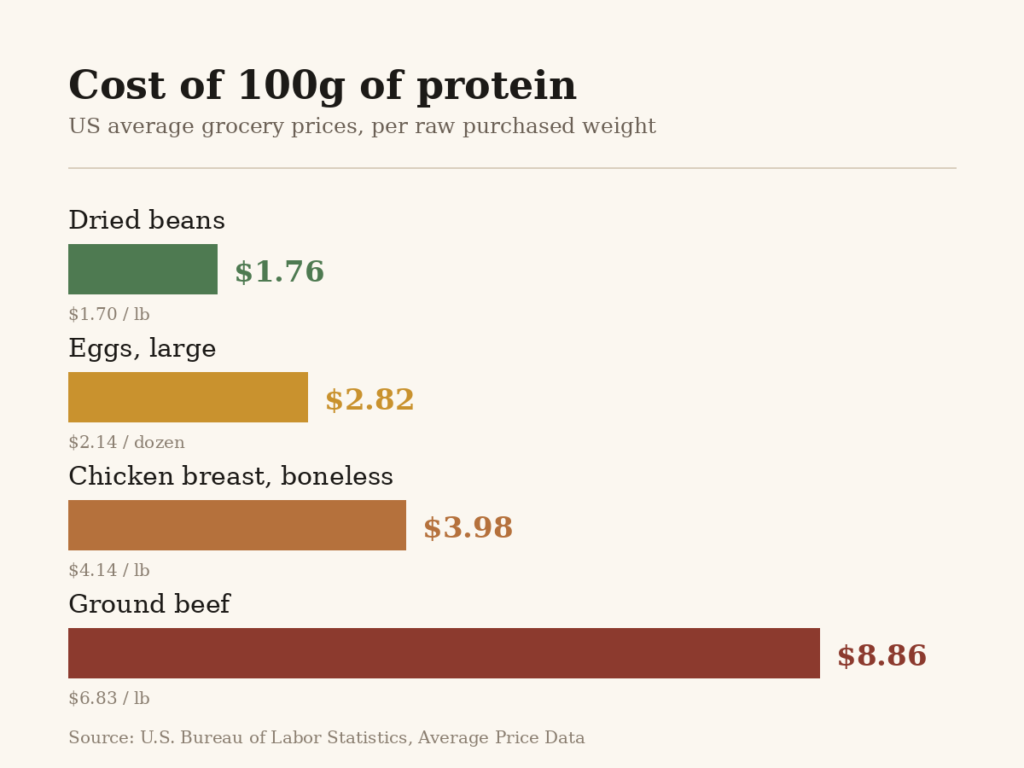
Price source: https://fred.stlouisfed.org/series/APU0000714233 https://fred.stlouisfed.org/series/APU0000708111 https://fred.stlouisfed.org/series/APU0000706111
BLS Average Price Data, U.S. city average, via FRED (series APU0000714233, APU0000708111, APU0000FF1101, APU0000703112). Protein values are USDA figures for the raw food.
Three things fall out of this immediately.
Eggs beat chicken breast, and it is not close. A dozen eggs delivers protein about 30 percent cheaper than the boneless skinless chicken breast every budget listicle recommends. Egg prices came down hard from their 2025 peak, and the advice has not caught up.
Dried beans beat everything by a factor of two. Not canned beans, dried. The bag of pinto beans is the single cheapest protein in the American supermarket and it is not particularly close to second place.
Ground beef costs five times what beans cost per gram of protein. If you eat beef three times a week out of habit rather than preference, that habit is where your grocery budget is going.
The objection a nutritionist would raise, and they would be right
Protein is not one substance. Beans are lower in methionine, an essential amino acid, which means the body uses a smaller share of the protein in beans than it uses of the protein in eggs. Egg protein is the reference standard against which other proteins are scored, so beans lose some of the advantage the table gives them.
How much? Enough to narrow the gap, not enough to close it. Beans at $1.76 per 100 grams versus ground beef at $8.85 leaves a lot of room. And the classic fix has been on the table for centuries: grains supply the methionine beans lack, and beans supply the lysine grains lack. Beans and rice, lentils and bread, hummus and pita. Every poor cuisine on earth arrived at this pairing independently, which should tell you something.
The second honest caveat is yield. A pound of raw chicken breast loses about a quarter of its weight in cooking, and dried beans triple in weight when soaked. Neither changes the ranking, because I calculated everything on the raw purchased weight, which is what you actually pay for.
What this changes in a real cart
If you keep one thing from this, keep the substitution ladder rather than the table.
Replacing one beef dinner a week with a bean dinner saves more than most coupon strategies return in a month. Not because beans are magic, but because beef is the most expensive protein most households buy in volume.
Eggs are the best emergency protein in the store. Breakfast for dinner is not a compromise, it is arithmetic.
Buying chicken breast because it is “the cheap meat” is a habit from a different price environment. If you want chicken, thighs cost less per pound and the yield difference is smaller than people assume.
Do this yourself, because prices move
The reason nobody publishes this table is that it goes stale. Egg prices in particular swung violently through 2025 and 2026, and a ranking built on February data can be wrong by June.
So here is the method rather than just the answer:
- Go to FRED and search “Average Price” plus the food you want. Every series is free and updates monthly.
- Note the price and the unit, usually per pound or per dozen.
- Look up grams of protein per 100 grams in the USDA FoodData Central database, then multiply by 4.536 to get grams per pound.
- Divide price by protein grams, multiply by 100. That is your cost per 100 grams of protein.
Two rules if you want the result to mean anything. Use the same month for every food, or you are comparing a February bean to a June egg. And use raw weight throughout, because mixing raw and cooked weights is where most published versions of this comparison go wrong.
A note on my own numbers
The bean and chicken figures above are from February 2026, the egg and beef figures from June 2026, because those were the most recent readings published for each series when I built the table. That inconsistency is small relative to the gaps involved, but it is real, and I would rather state it than have you find it.