Food Inflation 2020-2026: What Actually Happened to Your Grocery Bill
Remember when a dozen eggs was just… a dozen eggs? No drama, no headlines, you just grabbed them and moved on with your life. Yeah, those were simpler times. Let’s actually walk through what happened to grocery prices over the last six years, because the vibes-based version (“everything got expensive and never came back down”) isn’t quite the whole story.
The rollercoaster, year by year
Grocery prices (what economists call “food at home,” basically anything you buy to cook yourself) rose a pretty normal 3.5% in both 2020 and 2021. Annoying, sure, but nothing wild. That’s close to the long-term average.https://americankitchentales.com/your-grocery-bill-isnt-the-problem/
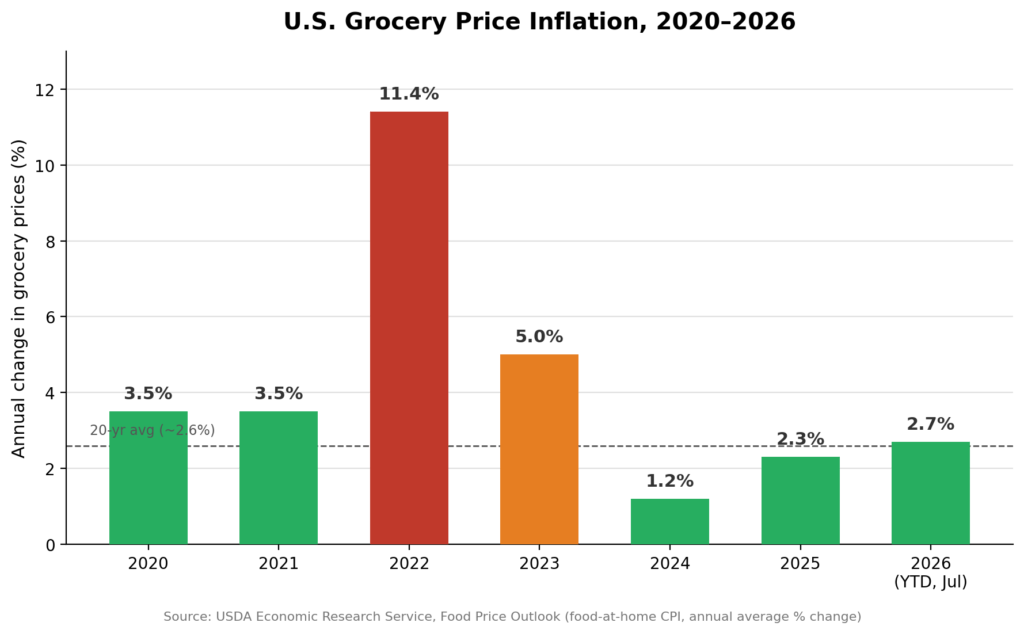
Then 2022 happened. Grocery prices jumped 11.4% that year, the fastest increase since 1979. Supply chains were a mess, a nasty bird flu outbreak wrecked egg and poultry supply, and the war in Ukraine sent grain and fertilizer costs through the roof. That’s the year everyone started actually looking at receipts instead of just tapping their card and walking out.
2023 cooled things down some, but grocery prices still climbed 5.0%, which is still well above normal. It wasn’t until 2024 that things really calmed down, with prices rising just 1.2% for the year, one of the mildest years in two decades. 2025 ticked back up slightly to 2.3%, and so far in 2026 we’re running around 2.7% year over year, basically back to a boring, historically normal pace.
So no, prices aren’t dropping back down to 2020 levels. Inflation slowing down just means prices are rising more slowly, not that they’re reversing. But the scary double-digit years are, for now, behind us.
The eggs saga deserves its own paragraph
Eggs are the poster child for all of this chaos, and the numbers are honestly a little unhinged. Before 2022, a dozen eggs mostly sat under $2. Then bird flu wiped out huge numbers of egg-laying hens, and prices more than doubled, peaking near $4.82 a dozen in January 2023. They cooled off for a bit, then the flu came roaring back and pushed prices to a fresh record of $6.23 a dozen in March 2025. As of this summer, they’ve fallen back to around $2.14 a dozen, less than half that peak.
If you were panic buying powdered eggs in early 2025, no judgment. That was a genuinely wild ride, and it wasn’t really about “inflation” in the normal sense, it was one virus messing with the entire supply chain for one specific product.https://www.ers.usda.gov/data-products/charts-of-note/105676
http://www.ers.usda.gov/data-products/charts-of-note/chart-detail?chartId=111015
What actually got more expensive (and what didn’t)
Not every category moved the same amount, which is the part people tend to forget. Beef and veal have been a consistent problem child, rising well above average multiple years in a row as the U.S. cattle herd shrank to historic lows. Eggs, obviously. Meanwhile things like fresh vegetables and cereal products have barely budged in the last couple of years, and some categories, like fats and oils, actually got a little cheaper recently.
That’s the real lesson buried in the data. “Grocery inflation” as a single number kind of hides what’s going on underneath it. Your bill might feel brutal if you’re buying a lot of beef and eggs, and barely different at all if your cart is mostly pasta, rice, and frozen vegetables.
So is it actually better now?
Kind of, in the sense that the rate of increase has calmed way down. But prices are cumulative, they don’t reset. Grocery prices are still something like 30% higher than they were at the start of 2020, even with the recent cooldown. Slower inflation just means your bill is climbing at a normal pace again, not that anything got cheaper.
If your grocery bill still feels heavier than it used to, that’s not you being bad with money. That’s just math.